Market Insights
Mini Excavator Applications: 5 Key Industries Where Compact Excavators Excel in 2026

Mini Excavator Applications: 5 Key Industries Where Compact Excavators Excel in 2026
From tunnels to backyards — here’s how compact excavators are taking on jobs full-size machines can’t touch, and why global demand is growing at 6.2% CAGR.
A 1.5-ton machine that fits through a standard door frame, rides a basic trailer, and digs down to 2.5 meters sounds too good to be true — until you see one working inside a city sewer line or lifting through a residential elevator.
Mini excavators (also called compact excavators, micro diggers, or small excavators) are the fastest-growing segment in the construction machinery market. With a projected market size of $12.8 billion by 2027 and a CAGR of 6.2%, these machines are no longer just “smaller versions” of full-size excavators — they are purpose-built tools for specific applications that large equipment simply cannot handle.
This guide breaks down the 5 key mini excavator applications driving demand worldwide in 2026, with real usage scenarios, machine size recommendations, and buying considerations for each industry.
1. Tunnel Engineering: Where Size Makes the Difference
Tunnel projects present a unique challenge — confined height, limited width, and zero room for maneuver. A standard 20-ton excavator simply cannot enter most tunnel faces, especially in subway, railway, and water diversion tunnels where headroom is often under 3 meters.
This is where mini excavators shine. With an overall height of just 2.2–2.5 meters (including the cab), a 1.5–3 ton mini excavator fits comfortably inside most tunnel profiles. Key tunnel applications include:
- Face cleaning and mucking — clearing debris after blasting or TBM advance
- Drainage ditch cutting — excavating side drains along tunnel walls
- Cable and pipe trenching — digging narrow, precise channels for utilities
- Shotcrete backup — positioning and trimming shotcrete surfaces
Major tunnel projects across China, Southeast Asia, and the Middle East increasingly specify mini excavators in their equipment fleets. The China Railway Engineering Corporation (CREC) alone operates over 1,200 mini excavators across its tunnel projects, citing a 40% reduction in manual labor costs where compact machines replace hand digging.
Recommended size: 1.5–3 ton class for tunnels with 3–4 m headroom. Zero-tail-swing models preferred for tight turning spaces.
2. Indoor Renovation and Demolition
Urban renewal projects create some of the most space-constrained working conditions in construction. Narrow doorways, passenger elevators, staircases, and weight-limited floor slabs all restrict what equipment can enter a building.
A 1-ton mini excavator, stripped of its cab and fitted with a purpose-built demolition breaker, can be transported through a standard residential elevator (typically 2.1 m × 1.2 m) and operated inside a room to break walls, remove floor slabs, and load debris.
Common indoor renovation applications:
- Wall and partition demolition — breaking brick and lightweight concrete walls
- Floor and slab removal — tearing up old concrete floors for replanning
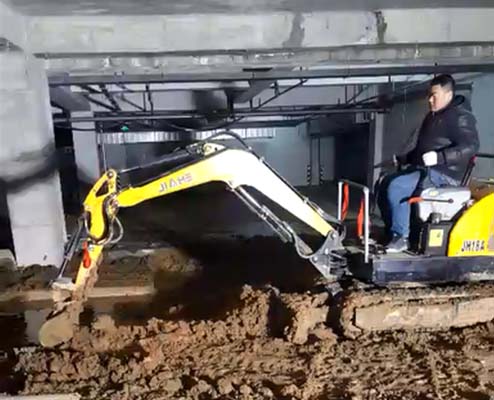
- Underground parking conversions — transforming parking levels into commercial space
- Basement excavation — digging deeper basements under existing structures
In cities like Shanghai, Guangzhou, and Shenzhen, where land costs drive vertical redevelopment, mini excavators have become standard equipment for renovation contractors. A 1–1.8 ton machine with a hydraulic breaker attachment can save up to 60% in labor cost compared to manual demolition.
Recommended size: 1–1.8 ton class, cab-off models with rubber tracks to protect finished flooring. Hydraulic breaker quick-attach is essential.
3. Gardening, Landscaping and Horticulture
Landscaping projects demand precision, minimal ground disturbance, and the ability to work around existing trees, irrigation lines, and decorative features. Full-size excavators are overkill — and often damaging — for garden work.
Mini excavators excel in landscape applications because their low ground pressure (as low as 0.25 kg/cm² with rubber tracks) and narrow width (under 1 meter) let them work on soft soil without compacting it, and maneuver through garden gates and pathways.
Key landscaping applications:
- Trench digging for irrigation and drainage — precise, narrow trenches with minimal soil disturbance
- Tree planting and root ball extraction — digging holes up to 1.5 m deep for new trees, or extracting old stumps
- Pond and water feature excavation — shaping natural-looking ponds and streams
- Terracing and slope preparation — leveling garden terraces on hillside properties
- Path and driveway preparation — grading base layers for paving stones or gravel
A 2–3.5 ton mini excavator with a swivel arm and rotatable bucket can handle 90% of landscaping excavation tasks on its own, replacing a crew of 8–10 laborers with shovels. In the UK and European markets, over 65% of landscaping contractors now own or lease at least one mini excavator.
Recommended size: 1.5–2.5 ton class with rubber tracks for lawn-friendly operation. A swivel boom (offset arm) greatly increases flexibility around existing structures.
4. Municipal and Utility Projects
Municipal infrastructure work — drainage, water supply, sewer lines, power cables, telecom ducts — runs predominantly through urban streets and residential neighborhoods. Access is restricted by existing buildings, traffic, underground utilities, and tight working windows.
Municipal contractors prefer mini excavators for these jobs because they require minimal traffic disruption, fit into standard parking lane widths, and can be quickly transported between worksites on a light truck.
Typical municipal applications:
- Storm drainage trenching — excavating 500–800 mm wide trenches for drainage pipes
- Water main repair — exposing and accessing buried water pipes without damaging adjacent utilities
- Sewer line installation and maintenance — digging access pits and lateral connections
- Cable and fiber optic trenching — precise, narrow trenches for telecom and power cables
- Curb and sidewalk preparation — grading and excavation for concrete formwork
In Chinese municipal projects, mini excavators have become the primary earthmoving tool for utility work, with cities like Chengdu and Wuhan deploying fleets of 3-ton mini excavators for their underground pipe network maintenance. A typical 3-ton machine can complete drainage trenching for 80–100 meters per day — roughly 5–6 times faster than manual excavation, and at one-third the cost of deploying a 20-ton excavator for the same task.
Recommended size: 2.5–3.5 ton class with dozer blade for backfilling. Hydraulic quick coupler recommended for rapid attachment changes between digging, breaking, and compacting.
5. Small Earthworks and Site Preparation
Small earthworks — grading building pads, backfilling foundations, leveling garden plots, preparing road bases — constitute the largest volume of mini excavator work globally. These are jobs that need machine efficiency but cannot justify the mobilization cost and site space of a full-size excavator.
Key small earthwork applications:
- Site leveling and grading — preparing flat building pads for small structures, greenhouses, or parking areas
- Foundation trenching — digging narrow strip footings for residential and light commercial buildings
- Backfill and compaction — refilling trenches and compacting in layers using the dozer blade
- Ramp and access road grading — rough grading and shaping unpaved access roads
- Ditch cleaning and maintenance — clearing silt and vegetation from drainage ditches and canals
The versatility of mini excavators in small earthworks comes from their ability to switch between digging, grading, and backfilling without changing machines. A single 3.5-ton mini excavator with a dozer blade and quick coupler can handle 80% of tasks on a small construction site — from initial earthmoving to final grading.
For agricultural applications, mini excavators are increasingly used for farm drainage, livestock barn foundation preparation, and pond construction. Their low transport cost means farmers can bring in a machine for a single day’s work without the logistics burden of heavy equipment transport.
Recommended size: 2.5–3.5 ton class with dozer blade and swivel boom. Rubber tracks for grass-friendly operation, steel tracks available for rocky ground.
Recommended Products
At CMPartsCN, we supply wear parts and attachments for all major mini excavator models. Contact us at info@cmpartscn.com or WhatsApp +852 60391704 for pricing and model fitment.
Frequently Asked Questions
What size mini excavator do I need for tunnel work?
For most tunnel projects with 3–4 meter headroom, a 1.5–3 ton mini excavator with zero tail swing is recommended.
Can a mini excavator fit through a standard door?
Yes. A 1–1.5 ton mini excavator with the cab removed typically measures 700–900 mm wide and 1,800–2,000 mm tall.
What attachments are most useful for landscaping?
A swivel boom is the most versatile. Also: trenching bucket, stump grinder, grading bucket, and hydraulic auger.
How deep can a 1.5-ton mini excavator dig?
Most 1.5-ton class mini excavators achieve a maximum digging depth of 2.2–2.6 meters.
Are mini excavators good for demolition work?
Yes, when fitted with a hydraulic breaker. For indoor demolition, a 1–2 ton machine is ideal.
How much does a mini excavator cost in 2026?
New Chinese-brand 1.5-ton mini excavators range from $8,000–$20,000. CMPartsCN can help source brand-new OEM units at factory-direct prices.
Need help sourcing mini excavator parts? Mail us at info@cmpartscn.com or WhatsApp +852 60391704 for a quote.