

Market Insights
Save $30K/Year Per Machine? Why Chinese Electric Loaders Are the Smart Choice for Tunnel Contractors

You’re spending more on ventilation than on fuel. Most tunnel contractors don’t add it up.
A single diesel loader in a tunnel burns about $120–180 in fuel per day. That same loader forces you to run massive ventilation fans — another $200–400 per day — just to keep diesel exhaust below hazardous levels. Add health risks, compliance paperwork, and early engine rebuilds from the constant dust-and-soot cycle.
The total? Around $100,000 per year per machine just to operate diesel underground.
There’s a better way. China-made electric wheel loaders have been running in tunnels across Asia for the past three years. The numbers are in. Here’s what they show.
Diesel vs. Electric: The Tunnel Math
| Cost Factor | Diesel Loader | Electric Loader |
|---|---|---|
| Fuel/energy per day | $120–180 | $30–50 |
| Ventilation cost per day | $200–400 | $100–200 |
| Maintenance per year | $8,000–12,000 | $4,000–6,000 |
| Daily total (8-hr shift) | $350–600 | $140–260 |
| Annual cost per machine | ~$90K–130K | ~$40K–65K |
| CO₂ emissions per shift | ~180 kg | 0 |
The electric loader saves $30K–35K per year on a single shift. Run two shifts? Double it.
Why Electric Loaders Are Built for Tunnels
1. Zero Tailpipe Emissions = Cheaper Ventilation
This is the biggest savings most contractors miss.
Diesel loaders emit CO, NOx, and particulate matter inside enclosed tunnels. Every country has strict exposure limits — under OSHA, the PEL for diesel particulate is 160 μg/m³. To stay compliant, you need massive ventilation: extraction fans, filtration systems, fresh air ducts.
Electric loaders produce zero exhaust. You still need ventilation for dust and blast fumes, but you can cut the extraction capacity in half. That’s $100–200 per day back in your pocket.
Our customers report ventilation savings of 40–60% after switching to electric.
2. Instant Torque. No Lag.
Electric motors deliver maximum torque from 0 RPM. A diesel engine needs to spool up — in a tunnel, where you’re constantly stopping, reversing, and loading, that lag costs cycle time.
The JGM857E’s 220kW motor gives you 180 kN of breakout force from a standstill. Operators tell us the first scoop feels stronger than a comparable diesel machine. No clutch, no gear hunting, just power on demand.
3. Quiet Enough to Hear Safety Calls
Tunnel work is dangerous. A diesel loader running at 85–90 dB masks backup alarms, radio calls, and warning shouts.
Electric loaders run at 65–75 dB — about half the perceived noise. Workers communicate better. Safety incidents from misheard signals drop noticeably.
4. Fast Charging + Battery Swap for Continuous Operation
Worried about range? Here’s how it works in practice:
- Standard charge: 1 hour to 80% via 380V fast charger
- Battery swap: 5–6 minutes at an automatic swap station
- Run time: 6–8 hours per charge on a full shift
Most tunnel operations have natural breaks — lunch, shift change, blasting pauses. That’s enough for a top-up charge. For 24-hour operations, swap stations or dual-machine rotation keeps you running round the clock.
Three Real-World Scenarios
Scenario 1: Drill-and-Blast Tunnel (Typical Highway/Railway Tunnel)
The rhythm is predictable: drill → blast → ventilate → muck out → support. During the ventilation phase (20–40 minutes after each blast), the loader is idle. That’s a built-in charging window.
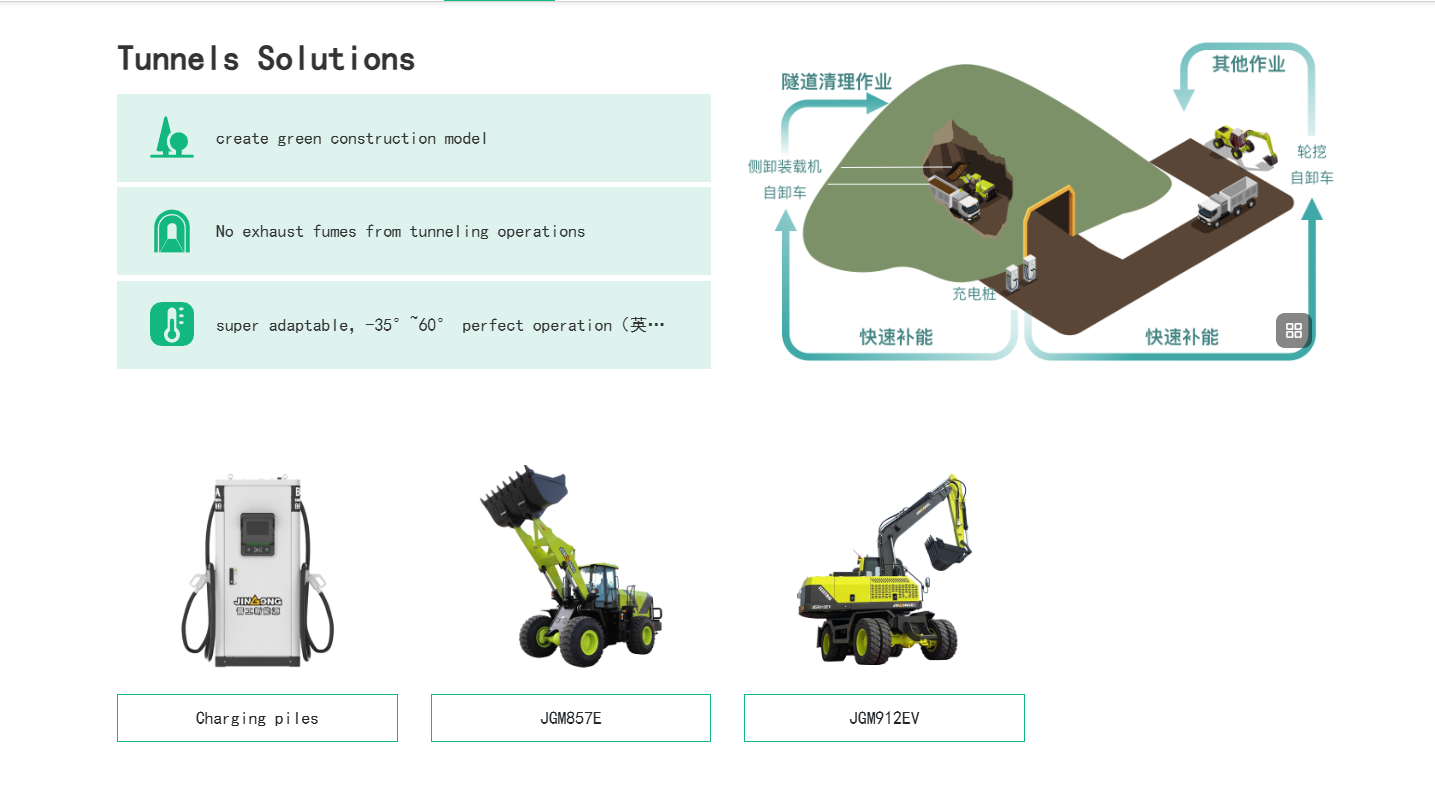
Best fit: JGM857E with fast charger. Charge during blast cycles. Run all shift on one battery.
Scenario 2: Small-Diameter Tunnel (Water/Utility Tunnel)
Space is tight. A standard diesel loader fills the tunnel with exhaust that has nowhere to go. Ventilation costs spike because air has to be forced through a small cross-section.
Best fit: Low-profile electric loader — no exhaust means no ventilation bottleneck. The savings are even bigger here because the ventilation power needed per cubic meter of tunnel volume is higher in small bores.
Scenario 3: High-Altitude Tunnel (Mountain Pass / Plateau)
Above 3,000 meters, diesel engines lose 20–30% power due to thin air. Fuel consumption goes up. Engine wear accelerates.
Electric motors don’t care about altitude. Power output is the same at sea level or 4,500 meters. For tunnel projects in the Andes, Himalayas, or Tibetan Plateau, electric is the only way to maintain rated performance.
Which Model Fits Your Tunnel?
| Model | Type | Power | Best For | One-Liner |
|---|---|---|---|---|
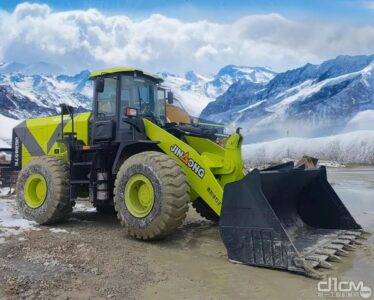
| JGM857E | Electric wheel loader | 220kW, 5-ton class | General tunnel mucking, 80% of jobs | “The tunnel workhorse — proven across 20+ sites” |
| JGM912EV | Electric excavator | 12-ton class | Tunnel face prep, scaling, heavy breaking | “Zero-emission partner for face work + mucking” |
Not interested in all the details? Skip to the FAQs below.
Frequently Asked Questions
How much can I really save switching from diesel to electric in a tunnel?
Let’s do the math on a 5-ton loader running one 8-hour shift: diesel fuel $120–180/day + ventilation $200–400/day + maintenance $30–50/day = roughly $350–600/day total. Electric: energy $30–50/day + reduced ventilation $100–200/day + maintenance $15–25/day = $140–260/day. That’s $25K–35K per year per machine on a single shift. Two shifts = $50K–70K.
What about battery range? Will it last a full shift in a tunnel?
Yes. Under normal tunnel mucking conditions, the JGM857E runs 6–8 hours per charge. Most tunnel operations have natural breaks — blasting pauses, lunch, shift change — that line up perfectly with recharge windows. A 380V fast charger brings it to 80% in about an hour. For 24-hour operations, you can rotate two machines or set up a battery swap station (5–6 minute swap).
Is an electric loader powerful enough for tunnel work?
More powerful than diesel in the ways that matter underground. Electric motors deliver maximum torque from 0 RPM — no spool-up lag. The JGM857E puts out 220kW with 180 kN breakout force. Operators consistently report better digging performance than the equivalent diesel model, especially in the first scoop.
How much does tunnel ventilation cost drop with electric loaders?
Our customers see 40–60% reduction in ventilation energy costs after switching. Diesel exhaust requires both high-volume extraction AND filtration. Electric loaders produce zero exhaust, so you only need ventilation for blast fumes and dust. In small-diameter tunnels where ventilation is the biggest operational cost, the savings are even more dramatic.
Do electric loaders work in high-altitude tunnels?
This is one of the biggest advantages. Diesel engines lose 20–30% of their rated power above 3,000 meters due to oxygen depletion. Electric motors deliver full rated power regardless of altitude. For tunnel projects in the Andes, Himalayas, or Tibetan Plateau, electric is actually more capable than diesel.
Can you customize loaders for narrow or small tunnels?
Yes. Our engineering team has done low-profile modifications for tunnels with tight cross-sections. We can adjust overall height, bucket width, and tire configuration to match your tunnel dimensions. Just send us your tunnel profile and we’ll give you a fit assessment.
What warranty comes with the equipment?
Standard: 12 months on the whole machine, 24 months on the core drivetrain components (motor, battery, controller). The lithium iron phosphate battery is rated for 4,000+ cycles — that’s about 10 years of daily use before capacity drops to 80%.
We’re outside China. Who handles maintenance and repairs?
Three-tier support: ① Remote video diagnosis handles ~90% of issues. ② Local partner technicians in most markets. ③ Our engineers can fly in for complex cases. Spare parts warehouses in Southeast Asia, the Middle East, and Africa. Common parts ship within 48 hours.
What charging setup do I need on site?
A standard 380V three-phase industrial power supply runs the fast charger. Most tunnel sites already have this for ventilation fans and pumping. If your site only has 220V, we include a slow charger that tops up overnight. For remote sites with no grid power, we can provide a mobile charging solution.
Do you offer operator training?
Free remote training in English or Chinese covering daily operation, charging procedure, and basic troubleshooting. For orders of 5+ machines, we send an engineer to your site for 3–5 days of hands-on training. Electric loaders are simpler to operate than diesel — no gear shifting, no clutch, just two pedals and a joystick.
Do electric machines meet global environmental regulations?
Zero tailpipe emissions means they comply with every emissions standard on earth: EU Stage V, EPA Tier 4, China National Phase IV. No aftertreatment systems needed, no DEF fluid, no DPF regeneration. They also qualify for green construction credits in many countries.
How long have you been in the construction machinery business?
Over 20 years exporting heavy equipment to more than 20 countries. We partner with Jingong New Energy — one of China’s leading electric construction machinery manufacturers — and our own factory spans 50,000+ square meters with annual production capacity of 2,000+ units.
Do you have actual tunnel customers using these machines?
Yes. Our electric loaders are deployed in tunnel projects across Southeast Asia, the Middle East, and China. The largest single order was 50+ units for a tunnel operation. Customers consistently report the savings numbers we’ve shared here — 40–60% lower ventilation cost, 30% lower maintenance, and operators who prefer the quieter, cleaner work environment.
This guide is based on real operating data from tunnel projects using Chinese electric loaders. The numbers will vary by site conditions, shift patterns, and local energy prices. Get in touch for a personalized savings estimate based on your tunnel profile.