

Market Insights
Autonomous Mining 2026: How AI & Electric Equipment Are Transforming China’s Mining Sites

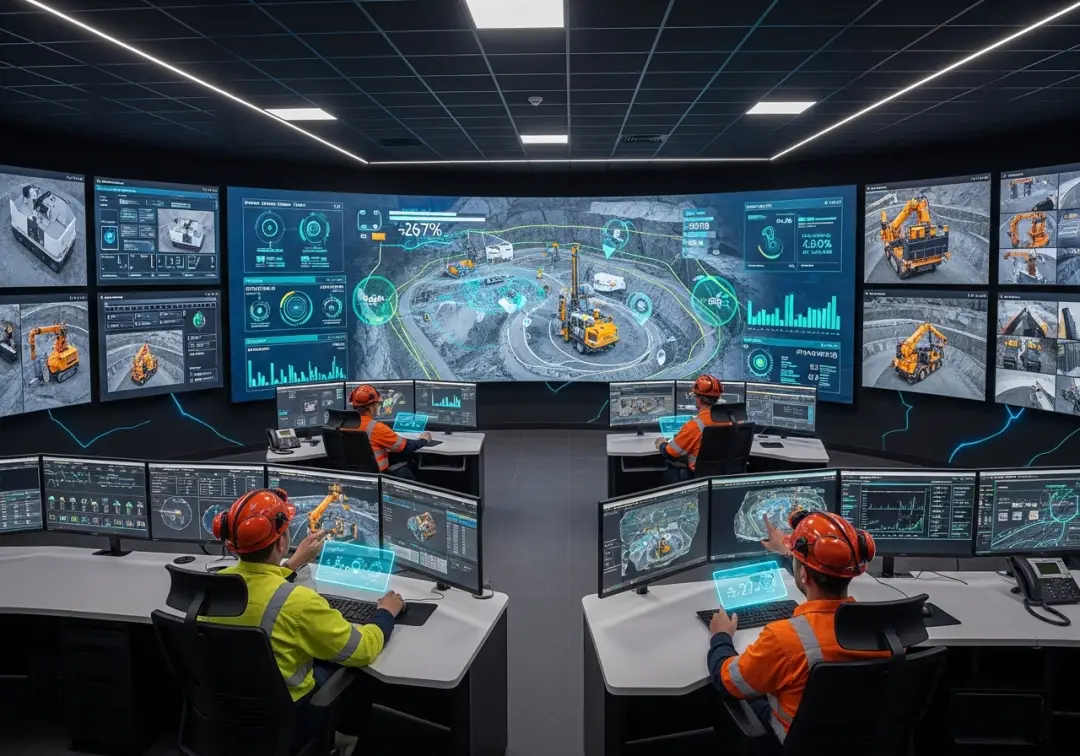
Autonomous mining is no longer a concept limited to the world’s largest copper mines in China or Australia’s iron ore giants. In 2026, mid-size and even small mining operations across Asia, Africa, and the Middle East are actively deploying AI-powered, electric mining equipment. The result is lower operating costs, improved safety, and a faster path to net-zero compliance.
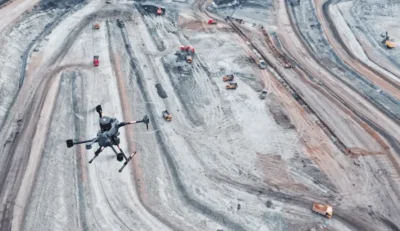
This article covers the full autonomous mining ecosystem — from AI-driven haul trucks and electric loaders to the charging infrastructure that makes it all possible — and shows how Chinese manufacturers are delivering complete, deployable solutions right now.
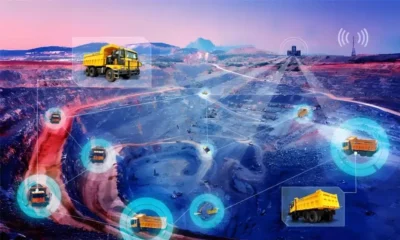
**Table of Contents**
– [The Autonomous Mining Market in 2026](#market-2026)
– [What Makes a Mine “Autonomous”? The Four Layers](#four-layers)
– [Mining Trucks: The Heart of Autonomous Haulage](#mining-trucks)
– [Electric Loaders & Excavators for Mining](#electric-loaders)
– [Charging & Battery Swap Infrastructure](#charging-infra)
– [Diesel-to-Electric Retrofitting: A Lower-Cost Path](#retrofit)
– [AI’s Role: Smart Dispatching, Predictive Maintenance, Safety](#ai-role)
– [How to Start Your Autonomous Mining Transition](#start-transition)
– [FAQ](#faq)
 ## The Autonomous Mining Market in 2026
The global autonomous mining equipment market is projected to reach USD 8.3 billion by 2030, growing at over 17% CAGR. Several forces are accelerating adoption:
– **Labor shortages** — Skilled mining equipment operators are increasingly hard to find and retain, especially in remote sites across Africa, Central Asia, and the Middle East.
– **Safety regulations** — Governments in Saudi Arabia (Vision 2030), UAE, and Indonesia are mandating progressive automation for new mining permits.
– **ESG pressure** — International buyers and investors require measurable emissions reductions from mining operations.
– **Total cost of ownership (TCO)** — Electric autonomous fleets reduce fuel costs by 60-80% and maintenance costs by 30-50% compared to conventional diesel fleets.
China, as the world’s largest mining equipment producer, is uniquely positioned to supply this transition.
## What Makes a Mine “Autonomous”? The Four Layers
A true autonomous mining solution integrates four technology layers:
| Layer | Technology | Example |
|——-|———–|———|
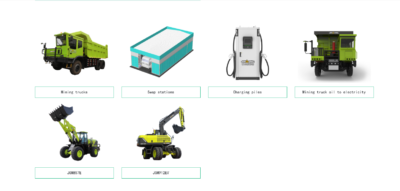
| 1. Electric powertrain | Battery-electric trucks, loaders, excavators | JGM857E electric wheel loader |
| 2. Intelligent driving | Autonomous navigation, obstacle detection, path planning | AI-based autonomous driving system |
| 3. Fleet management | Centralized dispatch, real-time tracking, predictive maintenance | Smart mining operations center |
| 4. Charging infrastructure | Fast charging, battery swap stations, renewable integration | Automated battery swap for mining trucks |
The most successful deployments combine all four layers into a single integrated solution, not piecemeal components from different vendors.
## Mining Trucks: The Heart of Autonomous Haulage
In any mining operation, haul trucks represent 40-60% of total operating costs. Autonomous electric haul trucks are the single biggest cost-saving opportunity.
**Key specifications for autonomous-capable mining trucks:**
– **Load capacity:** 65 to 95 tons (the sweet spot for mid-to-large mining operations)
– **Powertrain:** 100% battery electric, eliminating diesel fuel costs
– **Autonomy level:** L4 autonomous navigation with obstacle detection, GPS waypoint following, and remote supervision
– **Battery capacity:** Enough for 8-10 hours of continuous operation under full load
Chinese manufacturers like **Jingong New Energy** now produce autonomous-capable mining trucks (such as the Yongle-series haul trucks) with integrated battery swap compatibility, meaning the truck can exchange its battery pack in under 5 minutes — no charging downtime.
## Electric Loaders & Excavators for Mining
While haul trucks move material between zones, loaders and excavators handle the actual loading and digging. Electric versions of these machines are already in active mining service.
**Electric Wheel Loaders for Mining:**
The **JGM857E** is a 5-ton electric wheel loader widely deployed in mining, quarry, and material handling operations. Key advantages:
– Zero emissions — critical for underground and pit operations
– 70% lower operating cost vs diesel equivalent
– Instant torque for faster bucket filling cycles
– Compatible with battery swap and fast-charge infrastructure
**Electric Excavators for Mining:**
The **JGM912EV** electric excavator brings the same benefits to digging and loading operations. With high breakout force and a fully electric drivetrain, it matches or exceeds diesel excavators in cycle time while eliminating fuel costs and emissions.
Both machines integrate with autonomous fleet management systems, enabling remote operation and eventually full driverless workflows.
## Charging & Battery Swap Infrastructure
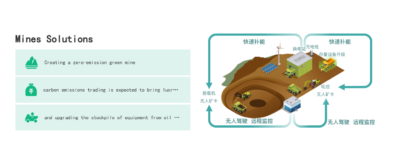
For an autonomous electric mine to work, you need three types of charging infrastructure:
1. **Fast charging piles** — For opportunity charging during shift changes (30-60 minutes to 80%)
2. **Battery swap stations** — For high-utilization vehicles, particularly haul trucks and loaders, full battery exchange in under 5 minutes
3. **Stationary storage** — Buffer batteries that smooth grid demand and integrate with on-site solar or wind
A complete mining electrification solution includes all three. Chinese suppliers now offer turnkey infrastructure deployment as part of their equipment packages.
## Diesel-to-Electric Retrofitting: A Lower-Cost Path
Not every mining operation can afford a full fleet replacement. That’s where diesel-to-electric retrofitting comes in.
Retrofit providers take an existing diesel mining truck or loader and replace:
– The diesel engine with an electric motor + battery pack
– The hydraulic system with electric-over-hydraulic actuation
– The control system with autonomous-capable electronics
The result is a machine that performs like new electric equipment at roughly 40-60% of the replacement cost. Major retrofitting programs are already active in China, with completed conversions operating in mines across Xinjiang, Inner Mongolia, and overseas.
## AI’s Role: Smart Dispatching, Predictive Maintenance, Safety
Autonomous mining is not just about removing the driver. AI software manages the entire operation:
**Smart dispatching.** AI algorithms assign haul trucks to loaders in real time based on queue length, material type, grade requirements, and truck battery levels. This alone can improve fleet utilization by 20-35%.
**Predictive maintenance.** Vibration sensors, thermal cameras, and battery management data feed into ML models that predict component failures 2-7 days in advance. The system schedules maintenance during low-demand windows, reducing unplanned downtime by up to 60%.
**Safety monitoring.** Computer vision continuously scans the work area for personnel, obstacles, and hazardous conditions. In the event of an anomaly, the system can slow or stop vehicles autonomously.
**Fleet integration.** A cloud-based operations center connects all vehicles, charging infrastructure, and the dispatch system into a single dashboard view. The mine manager sees real-time productivity, energy consumption, and equipment health from a tablet.
## How to Start Your Autonomous Mining Transition
For mining operators considering the transition, here is a practical three-phase approach:
**Phase 1 — Electrify (6-12 months)**
Replace the highest-consumption diesel machines with electric equivalents. Start with wheel loaders (fastest ROI), then haul trucks. Install charging infrastructure.
**Phase 2 — Automate (6-12 months)**
Deploy autonomous driving retrofits on existing electric equipment. Integrate fleet management software. Run one autonomous zone in parallel with conventional operations.
**Phase 3 — Optimize (ongoing)**
Connect all equipment to the AI dispatch system. Add predictive maintenance. Scale the autonomous zone to 100% of operations.
CHINA Construction Machinery supplies electric mining equipment including the JGM857E wheel loader and supports turnkey autonomous mining projects through its partnership network.
**Q: How much does an autonomous mining solution cost?**
A: Costs vary by site size and existing equipment. A mid-size mine transition typically costs USD 5-15 million for vehicles, infrastructure, and software. Most operators see payback within 2-3 years through fuel, labor, and maintenance savings.
**Q: Can existing diesel equipment be converted to electric?**
A: Yes. Diesel-to-electric retrofitting is available for most mining trucks and loaders. This costs 40-60% of new equipment price and delivers similar performance.
**Q: How long does a battery charge last in a mining truck?**
A: Modern electric mining trucks operate 8-10 hours on a full charge under heavy load. Battery swap stations can exchange the pack in under 5 minutes, effectively eliminating downtime.
**Q: What level of autonomy is available for mining equipment?**
A: Current systems operate at L4 autonomy — full autonomous driving within defined mine zones with remote supervision. The transition to L5 (fully unmanned, all conditions) is expected within 2-3 years.
**Q: Is autonomous mining safe?**
A: Yes. AI safety systems continuously monitor for personnel, obstacles, and hazardous conditions. Autonomous operations have demonstrated 60-80% fewer safety incidents compared to conventional operations in published case studies.
**Q: Which markets are adopting autonomous mining fastest?**
A: China, Australia, Chile, Saudi Arabia, and Indonesia lead adoption. Middle Eastern and Central Asian markets are growing rapidly due to new mining projects and government automation mandates.
—
*CHINA Construction Machinery (cmpartscn.com) supplies electric wheel loaders, mining equipment, and supports autonomous mining project deployments. Contact us at donald@cmpartscn.com for equipment specifications and project consultation.*
One thought on “Autonomous Mining 2026: How AI & Electric Equipment Are Transforming China’s Mining Sites”