
Market Insights
How to Find a Reliable Excavator Bucket Teeth Factory in China


The global excavator bucket tooth market was valued at USD 974 million in 2024 and is projected to reach USD 1.76 billion by 2032, growing at 7.13% CAGR [来源: Credence Research]. China alone produces over 60% of the world’s bucket teeth across four major manufacturing clusters.
But here’s the problem most buyers face: they pick a factory based on price alone, then deal with teeth that crack in 2 weeks, dimensions that don’t fit the excavator, or shipments that arrive 3 months late.
This guide walks through a 4-step system to find a reliable bucket teeth factory — matching process to your working conditions, verifying factory capability on 5 hard criteria, testing samples before bulk ordering, and negotiating prices that make sense for both sides.
Excavator teeth manufacturing – forged tooth cross section
Step 1: Match the Manufacturing Process to Your Working Conditions
The first mistake buyers make is contacting factories before knowing what type of bucket teeth they actually need. Different processes suit different jobs, and picking the wrong one will fail regardless of who makes it.
Forged Bucket Teeth — For Heavy Rock and Mining
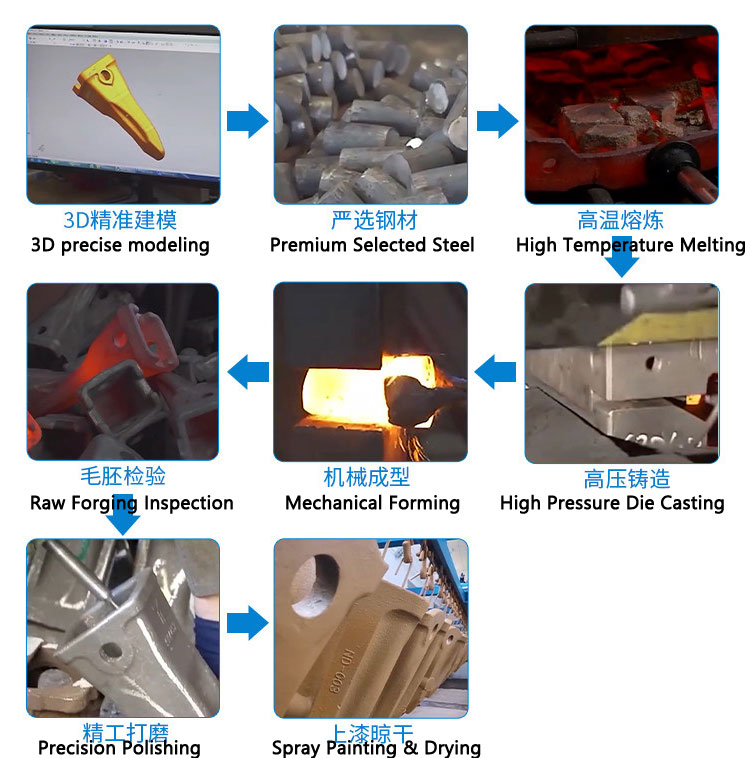
Forged teeth are made by heating steel billets to 1100–1200°C and hammering them into shape under high pressure. This gives them a dense grain structure that resists impact and cracking.
Common materials: 42CrMo, 23MnNiMoCr54, or high-manganese steel (Mn13). Hardness range: HRC 45–54.
Best for: Mining operations, hard rock excavation, large excavators (30+ tons). Heavy loads and constant impact make forged teeth the safer choice.
Cast Bucket Teeth — For General Earthmoving
Investment-cast teeth use wax patterns and ceramic shells to form precise molds. They offer good wear resistance at a lower cost than forged teeth.
Best for: General excavation, sand and gravel, municipal earthmoving projects where impact loads are moderate.
Avoid: Small workshops using basic sand casting without heat treatment. These teeth look fine at first but wear out fast.
Precision Casting (Investment Casting) — The Middle Ground
Also called lost-wax casting, this method produces teeth with tighter tolerances (±0.1–0.2mm) and smoother surfaces than sand casting. The material is still cast-grade but the process gives better consistency.
Best for: Medium-duty excavators (15–30 tons), export orders where dimensional accuracy matters, and mix-and-match orders covering multiple models.
Step 2: The 4 Major Bucket Teeth Manufacturing Clusters in China
China’s bucket teeth production is concentrated in four regions. Each has strengths based on the local industrial ecosystem and historical specialization.
| Cluster | Core Cities | Specialty | Best For |
|---|---|---|---|
| Shandong | Linyi, Weifang | Largest production capacity, cast teeth at volume pricing | Cost-sensitive bulk orders, standard models |
| Jiangsu | Xuzhou, Changzhou | High-end forging, OEM supplier network around XCMG | Heavy-duty orders, export to tier-one markets |
| Anhui | Ningguo | “Wear-resistant casting capital” — mature heat treatment tech | Medium-size factory partnerships, stable quality |
| Henan | Luoyang, Jiaozuo | Heavy industrial base, large forging capacity, deep steel supply chain | Heavy mining teeth, large-tonnage excavator teeth |
The Henan cluster deserves special attention for heavy-duty orders. Luoyang has been a heavy-manufacturing hub since the 1950s — home to CITIC Heavy Industries, China’s oldest heavy machinery builder, and a dense supply chain for forging-grade alloy steels. Factories here have decades of experience with large-format forgings that smaller clusters cannot match.
One example: Luoyang Taihang Machinery (洛阳市孟津县太航机械有限公司), established in 1997, has been producing bucket teeth and mechanical components for nearly 30 years. They handle forging, CNC machining, and heat treatment in-house — the kind of vertically integrated setup that signals a real factory, not a trading company [来源: CMPartsCN supplier database].
Step 3: 5 Standards to Verify a Real Factory
Standard 1: Own Production Lines — No Trading Companies
A genuine factory controls every step: melting furnace → forging or casting line → continuous heat treatment → CNC machining → inspection. If the “sales manager” can’t show you a workshop tour or is vague about which steps are outsourced, you’re likely talking to a middleman.
Red flags:
- No continuous heat treatment line — just a few quenching tanks. Guaranteed to skip tempering.
- Can’t show furnace or forging workshop, only the finished-goods warehouse.
- Business license shows “sales” or “trade” as primary activity, not “casting/forging manufacturing.”
Standard 2: Testing Equipment On-Site
You cannot judge heat treatment quality by looking at a tooth. You need equipment.
Must-have instruments:
- Optical emission spectrometer (OES) — verifies steel chemistry (Cr, Mo, Ni, Mn content)
- Rockwell hardness tester — measures HRC to ±1
- Metallographic microscope — checks grain structure after heat treatment
- Ultrasonic flaw detector — finds internal cracks or porosity
Ask the supplier: “Can you provide a melt-spectrum report, hardness certificate, and NDT report per batch?” A workshop with no spectrometer is buying scrap steel by weight and guessing at the chemistry.
Standard 3: Shop Floor Discipline
Walk through three areas during a factory visit. Each tells a different story:
Heat treatment area: Real furnaces have digital temperature displays with full time-temperature recording charts. Small workshops rely on a veteran worker’s “feel” — batch-to-batch hardness will swing by HRC 8–10.
Raw material yard: Alloy steel billets sorted and tagged by grade. Mixed scrap is a sign the factory uses whatever steel is cheapest that day.
Workshop cleanliness: Routine maintenance logs on equipment, organized tool storage, workers wearing proper PPE. Sloppy workshops produce sloppy teeth.
Standard 4: Customer Base Matches Your Use Case
For mine-site buyers: ask for proof of ongoing supply to mining operations, not just one-off sample orders.
For export buyers: request customs clearance records showing regular shipments to the Middle East, Southeast Asia, or Africa. A factory that only sells domestically won’t understand packing for sea freight or required certifications.
“We made parts for Caterpillar once” with no repeat orders is not a reference.
Standard 5: Inventory Capacity Before You Order
A serious factory keeps 1,000+ pieces of standard models in stock. Factories that only have samples and need to “schedule production” for every order are at the mercy of their foundry schedule — any spike in demand means 8- to 10-week lead times and possible price renegotiation.
Step 4: Sample Testing — The Only Way to Be Sure
Order identical samples from 2–3 shortlisted factories. Test four things:
| Test | What to Check | Pass/Fail Threshold |
|---|---|---|
| Weight | Compare against OEM or reference spec | Over 10% lighter = intentional material saving. Reject. |
| Hardness | Use a portable Leeb hardness tester on-site | Target HRC 45–54. Below 48 = soft, above 54 = brittle. |
| Pin fit | Test fit on a standard adapter | Gap ≤ 0.05mm acceptable. Loose fit wears the adapter fast. |
| Cross-section | Cut the tooth in half and etch | Uniform hardness through thickness = real heat treat. Only surface-hard = reject. |
Specimen cross-section test is the most revealing: a properly heat-treated tooth shows even hardness from the surface to the core. Cheap teeth receive only a surface quench — they feel hard on the outside but the core is soft, and they’ll snap under real loading.
Step 5: Pricing Strategy — Don’t Shop at the Bottom
Bucket tooth pricing in China follows a clear hierarchy:
- OEM-grade (Komatsu, CAT-spec): Highest. You pay for brand licenses and multi-layer distribution.
- Large direct-ship factories: 70–80% of OEM price. Best value — same materials, fewer middlemen.
- Medium specialized factories: Negotiable on bulk. Good for niche models.
- Small cottage shops: 50–60% of factory price. Teeth last 1/3 as long. False economy.
Negotiation tips:
- Quarterly blanket orders lock in 8–15% below spot price
- Full sets (teeth + adapters + pins) get bundle pricing
- Order in off-season (January–March) when foundries have capacity
- Don’t squeeze price without a liability clause for defective batches
Hidden costs to ask about upfront: Sea-worthy packaging (plywood cases + rust-proofing), FOB terminal fees, replacement terms for cracked teeth within warranty.
5 Types of Factories to Skip Entirely
- No heat treatment furnace — teeth painted and shipped raw. They’ll wear to nubs in days.
- Price 40% below market — they volunteer to “make them lighter to save you money.” That’s code for skimping on wall thickness.
- Cannot provide material certificates — “It’s all the same in this industry.” No it’s not.
- Logo-copying specialists — no own brand, no traceability batch numbers.
- Reconditioned old teeth — ground down, rewelded, sold as new. Hard to spot without cross-section testing.
For more information on excavator bucket teeth quality, check out our guide on Excavator Teeth Manufacturing: Genuine vs Fake and browse our Bucket Teeth product range.
Which Option Fits Your Needs?
Option A: Heavy Mining / Long-Term Site Use
Go with a Henan or Jiangsu forging specialist that runs its own die-forging line and continuous heat treatment. Choose 42CrMo forged teeth. Higher upfront cost, but service life is 3–4x longer than cast teeth, and fewer machine change-outs save downtime cost.
Option B: Earthmoving / Export Volume
Go with a Shandong or Anhui foundry that does investment casting at scale. Standard models in stock, competitive bulk pricing, and export packing as standard. This is the sweet spot for most B2B buyers sourcing from China.
How CMPartsCN Can Help
Our team is based in Shanxi and works directly with factories across all four clusters — including our long-term partner Luoyang Taihang Machinery in Henan (founded 1997, full in-house forging and heat treatment). We source from the factory floor, not a catalog. Every order we ship includes batch material reports and hardness certificates.
If you’re looking for excavator bucket teeth and want to skip the trial-and-error, contact us with your machine model and working conditions. We’ll point you to the right process and the right factory — not the cheapest one, but the one that’ll keep your excavator running.