

Market Insights
Excavator Teeth Manufacturing: Genuine vs Fake Exposed 2026


Excavator Teeth Manufacturing: Genuine vs Fake Exposed 2026
Hard rock 15,000 PSI. A single tooth snaps. Machine stops. Hourly rate: $180 in lost production plus one damaged tooth holder that costs $220 to replace. All because someone saved $8 on a knockoff tooth.
We run a 2,000 sqm warehouse in Shanxi, China stocking 500K+ in construction machinery parts. Whether you are buying excavator teeth manufacturing from China or anywhere else, understanding the real production process is the only way to avoid expensive counterfeits. We’ve seen every trick in the book — from genuine Japanese steel forgings to recycled scrap pretending to be “high-manganese alloy.” Here’s exactly how real excavator teeth are made, and exactly how fakes cut every corner.
Part 1: Two Genuine Manufacturing Processes
1. Forged Teeth — Heavy-Duty, Longest Service Life
Forging is the premium process. Reserved for hard rock, granite, and heavy mining applications where a tooth failure means a $5,000+ downtime bill.
Materials Used
Three proven alloys dominate the forged tooth market:
- Mn13Cr2 — High-manganese steel. Top choice for impact-heavy mining. Self-hardens under repeated impact, getting tougher as it works.
- 42CrMo — Low-alloy wear-resistant steel. Excellent balance of hardness and toughness for general heavy digging.
- 23MnNiMoCr54 — Nickel-enhanced alloy for extreme low-temperature toughness (think Canadian oil sands or Siberian winter operations).
The Complete Forging Process (8 Steps)
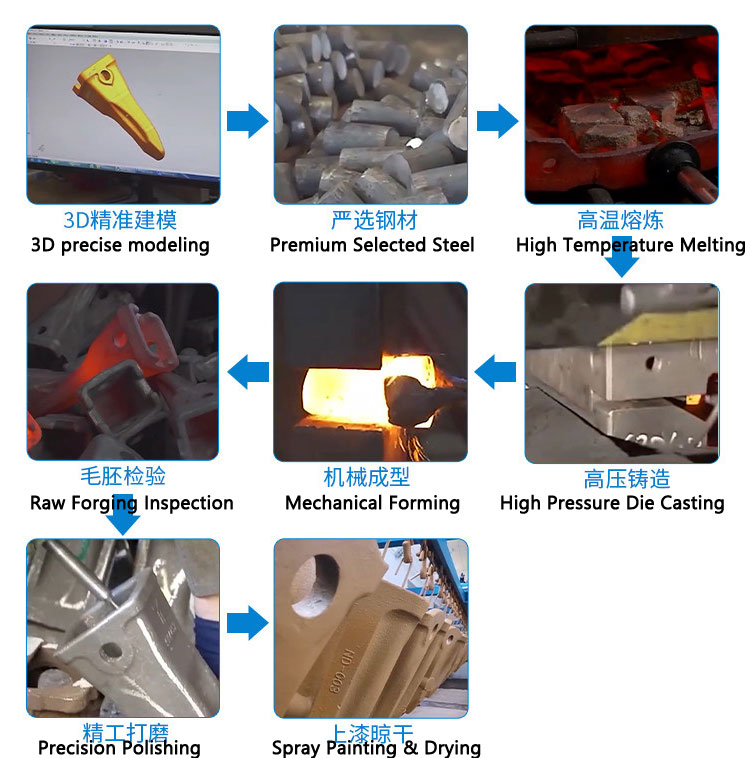
Step 1 — Raw Material Inspection
Every batch of steel billets goes through spectral chemical analysis. Carbon, manganese, chromium, nickel, sulfur, phosphorus — all elements are measured against the spec sheet. Sulfur and phosphorus must be ≤ 0.035% — anything above creates embrittlement. Surface defects (scale, cracks) are ground off before the billet enters the furnace. No recycled scrap. No mystery steel.
Typical skip in fake production: “The lab is real. The spectro report is printed and filed. Whether the actual melt matches it… that’s a different story.”
Step 2 — Gradient Preheating
The billet is first heated to 600°C (1,112°F) to relieve internal stress, then gradually brought up to 1,200–1,280°C (2,192–2,336°F) — the optimal forging temperature window. This two-step ramp prevents thermal shock cracking from the inside out.
Fake shortcut: throw cold steel straight into a 1,200°C furnace. The outside melts while the core stays cold. Internal cracks guaranteed.
Step 3 — Closed-Die Forging
The heated billet goes into an 8,000-ton hydraulic forging press. Multi-directional compression forces the metal grain structure to flow along the tooth’s load-bearing direction — exactly where stress hits during digging. This grain-flow alignment is what makes a forged tooth tough, not just hard. The process also eliminates internal porosity (gas pockets) and shrinkage cavities that plague cast parts.
Step 4 — Trimming, Sizing, and Pin Hole Machining
After forging, the flash (excess metal squeezed out around the die) is trimmed off. The tooth goes through sizing for dimensional accuracy. The pin hole is CNC-machined to ±0.1mm tolerance — tight enough that the tooth sits flush on the tooth holder with zero wobble.
Fake shortcut: drill the pin hole with a standard bit. Tolerance ±0.5mm if you’re lucky. The tooth rocks on the holder, wears out both parts, and falls off mid-dig.
Step 5 — Full Heat Treatment (The Most Critical Step)
This is where the real teeth earn their lifespan — and where fakes cut the deepest corners. The forged tooth undergoes a complete through-hardening cycle:
- Full solution treatment (water quenching) — Heated to 1,050°C, then rapidly quenched in water. The microstructure transforms completely, achieving surface hardness of HRC 45–55 at the tip.
- High-temperature tempering — Reheated to 350–450°C to relieve internal stresses from quenching. Without this step, the tooth is glass-hard but brittle as porcelain.
The result: hard exterior, tough core. The tooth surface work-hardens under impact (up to HRC 55+) while the core stays ductile enough to absorb shock without cracking. The harder you dig, the harder the surface gets.
This is the one step that separates a $25 tooth from a $12 one. And most fakes skip it entirely.
Step 6 — Shot Blasting and Coating
Oxide scale from heat treatment is removed by shot blasting. A rust-preventive coating is applied (typically black or dark gray for the export market).
Fake trick: heavy paint to hide surface defects — cracks, pinholes, shrinkage. Looks perfect in the box. Falls apart on day 3.
Step 7 — Quality Inspection
Every single tooth is tested:
- Hardness — tip, middle, and pin hole zones checked separately
- Weight — must match the spec within ±2%
- Dimensional check — pin hole diameter, tooth width, taper angle
- Flaw detection — magnetic particle or ultrasonic inspection for internal cracks
Step 8 — Serial Number Marking
Each tooth gets a laser-etched batch number and logo. Full traceability back to the melt batch. If a customer reports a failure, the factory can pull the exact batch’s production records and chemical analysis.
Fake: stamped or painted logo. No batch number. No traceability. “Made in China” with no factory name.
2. Investment Cast Teeth — Cost-Effective for General Earthmoving
In excavator teeth manufacturing, casting is the standard process for normal soil, sand, and gravel conditions. Two methods are common: silica sol investment casting (precision) and resin-coated sand shell casting (volume).
The Casting Process:
- Precision alloy melting with real-time spectrometer control during the pour
- Wax pattern injection → shell building → dewaxing → mold firing at 1,100°C
- Molten steel poured at controlled temperature, slow cooling to prevent internal stress
- Full quench + temper heat treatment — same as forged, because casting without heat treatment is just a soft metal shape
- Pin hole reaming, surface grinding, flaw inspection
- Weight check and dimensional gauge fit
Cast vs. Forged — Which One Do You Need?
| Factor | Forged Teeth | Cast Teeth |
|---|---|---|
| Best for | Hard rock, granite, mining | Soil, sand, gravel, general earthmoving |
| Grain structure | Aligned with stress direction | Random (crystalline) |
| Impact toughness | Excellent | Good to moderate |
| Service life (rock) | 600–1,000 hours | 300–500 hours |
| Service life (soil) | 1,200+ hours | 800–1,200 hours |
| Cost | Higher | Lower |
Part 2: How Fakes Cut Every Corner
The fake tooth market isn’t small operations. It’s a systematic industry of raw material theft, skipped processes, fake heat treatment, and cosmetic deception. Here are the five categories we see most often:
1. Raw Material Fraud — Cutting Cost at the Melt
Scrap steel re-melt: Recovered rusty steel plate, scrap channel steel, demolition waste — melted together with zero chemistry control. Sulfur and phosphorus levels (the brittleness elements) are 3–5x the allowable limit. The tooth looks right but breaks on the first rock encounter. Savings: 50–60% on raw material cost.
Carbon steel masquerading as high-manganese: Plain Q235 or 45# carbon steel instead of Mn13. Zero wear-resistant alloys. Hardness? Maybe HRC 20–25. These teeth wear flat in a few hours of digging in normal soil. Savings: the factory doesn’t buy expensive ferro-manganese, ferro-chrome, or nickel — the alloy additives that make wear steel wear-resistant.
External difference: zero. You can’t see the chemistry. You only feel it when your teeth are gone after lunch.
Alloy skimping: Nickel is the most expensive element in high-manganese steel (~$18,000/ton). Without it, low-temperature toughness drops by 40%+. A fake producer simply omits nickel and cuts chromium by half. The tooth passes a basic hardness test (because surface hardness can be achieved without a full alloy package) but shatters in freezing conditions. The new machine buyer in Mongolia or Canada discovers this on day one of winter operation.
2. Weight Reduction — The Easiest Cheat to Spot
A standard tooth for a 22-ton excavator should weigh about 6 kg (13.2 lbs). The fake weighs 4 kg (8.8 lbs) — a 33% reduction. Where does the weight go?
- Thinner wear zone at the tooth tip
- Thinner side walls where the tooth contacts the holder
- Thinner pin boss area (accelerates pin and holder wear)
- Hollow internal cavity masked by thick paint
The result: reduced cross-section means the stress per square millimeter is 50% higher than the design spec. The tooth either bends, cracks, or shears off the pin. And if the side walls are thin enough that the tooth rocks on the holder, the $220 tooth holder gets worn down too — a replacement that costs 10x the fake tooth you “saved” money on.
3. Heat Treatment Fraud — Invisible Until It Fails
In the excavator teeth manufacturing world, this is the most dangerous corner-cutting category because it’s entirely invisible to the buyer until the tooth is in the ground. The fake looks identical to a genuine tooth, has the same weight, the same surface finish — but will fail in 1/3 the time.
Skin-hardening only (skip the core): A thin 1–2mm layer at the tip is induction-hardened. The entire core remains soft steel. Test it with a file and the tip feels hard. Put it in rock and after the wear zone passes 2mm, the soft interior erodes at 3x the rate. Lifespan: 300 hours instead of 900.
The buyer’s tell: once the gray coating wears off (anywhere the black/gray paint disappears), inspect the fresh metal. If the cross-section looks homogeneous and rough (not a fine-grained structure), you’re holding a skin-hardened fake.
Skipping tempering entirely: Quenching without tempering leaves the steel with massive internal stress. The hardness reading looks good — maybe HRC 52 at the tip. But the tooth has zero toughness. Hit a buried rock or a ledge and the tooth explodes — fragments flying at high velocity. In a mining pit, this is a safety incident waiting to happen.
Loose temperature control: Real heat treatment requires precise furnace temperature control (±10°C) and controlled quench media (proprietary polymer quenchants). Fakes use whatever furnace is available (temperature swings of ±50°C) and water from the tap instead of quenchant. The batch-to-batch consistency is zero. Ten teeth from the same box may have hardness ranging from HRC 30 to HRC 50.
Complete omission of heat treatment: The tooth goes from casting straight to grinding → painting → shipping. It’s a raw metal casting with the hardness of mild steel. No detectable wear resistance. Pure waste of money — but the factory saved $1.50 per tooth on processing.
4. Crude Casting/forging — Structural Defects Guaranteed
Cheap sand casting: Instead of precision investment casting or closed-die forging, the fake uses ordinary green sand molds. The result is a tooth riddled with internal gas porosity, sand inclusion, and shrinkage cavities. These are invisible from the outside. The tooth cracks from the inside out under load.
Open-die hammer forging: Instead of an 8,000-ton closed-die press, the fake uses a pneumatic hammer hitting a block of steel placed between two simple dies. The grain flow is random or non-existent. The tooth’s internal structure is unidirectional — no stress-path alignment. The metal is coarse-grained from uncontrolled cooling. Crack initiation sites everywhere.
Oversized pin holes: The pin hole is drilled with a standard twist drill, not CNC-reamed. Tolerance: ±0.5mm instead of ±0.1mm. The tooth fits loose, accelerates pin and holder wear, and the whole assembly rattles until the pin breaks or the tooth falls off.
5. Brand Forgery and Cosmetic Deception
Fake brand stamps: Rough reproductions of SANY, Doosan, XCMG, or CAT logos. Font is slightly wrong. Depth is uneven. No batch number or QR code. Pure counterfeit — illegal in most markets.
Heavy paint to hide defects: A thick layer of industrial enamel covers every surface crack, pinhole, and shrinkage depression. Looks perfect in the unboxing video. After 2–3 shifts, the paint wears off and the defects emerge. By then, the reseller is long gone.
Reconditioned used teeth: Worn-out teeth from scrapped machines are collected, ground to remove the worn tip, re-welded with new material at the tip, ground smooth, and repainted. The welded tip has zero bonding with the base metal. It separates on the first hard impact. Sold as “factory new” — they’re not.
Part 3: The Real Cost of Cheap Teeth
Total Cost Comparison — 22-ton Excavator Example
| Metric | Genuine Tooth | Fake / Inferior |
|---|---|---|
| Unit price | $20–26 | $12–16 |
| Service life (hard rock) | 600–900 hours | 200–350 hours |
| Sets needed per 1,000 hours | 1–1.5 sets | 3–5 sets |
| Cost per 1,000 hours (parts only) | $22–27 | $30–54 |
| Downtime for replacement | ~1 hour | ~1 hour × 3–5x = 3–5 hours |
| Estimated lost production (1,000 hrs) | $180 loss | $540–900 loss |
| True total cost per 1,000 hrs | $202–207 | $570–954 |
Key insight: The cheap tooth isn’t cheaper. It’s 2.8–4.7x more expensive when you account for the full operating cost. And that’s before factoring in tooth holder or pin damage.
Secondary Damage Costs
- Tooth holder damage: A worn or loose fake tooth accelerates holder wear by 3–5x. Replacement: $150–220 per holder. A full set of 5 holders: $750–1,100.
- Pin damage: Loose fit = faster pin wear. Pins failing mid-operation = lost tooth + possible secondary damage to the bucket or surrounding equipment.
- Safety risk: A tooth that snaps under load at a mining site isn’t just a cost issue. Fragments traveling at speed can injure workers or damage nearby machinery. Reported incidents exist — including bucket structure fractures from high-speed tooth fragments.
Quick Field Checks — Spot the Fake in 30 Seconds
| Check | Genuine | Fake |
|---|---|---|
| Weigh it | Matches spec (±2%) | 10–33% underweight |
| Tap with a wrench | Clear, ringing sound — like a bell | Dull, flat thud |
| Fit test on a known holder | Tight, no lateral play | Loose, rocks side to side |
| Logo and markings | Laser-etched, uniform depth, batch number present | Stamped or painted, shallow, no batch trace |
| Paint thickness | Thin, even coating | Thick paint — check hidden surfaces like the inside of the pin hole |
How We Source at CMPartsCN
We work directly with two established foundries — one in Luoyang (founded 1997, specializing in high-manganese steel) and one in Chengdu (full casting + heat treatment line with in-house spectro analysis). Every batch is tested before shipment. We weigh, hardness-test, and visually inspect each tooth before it goes into our warehouse.
We don’t claim to be the cheapest. We claim to be the ones who send you teeth that stay on the machine.
Need teeth for your specific machine model?
Send us your OEM part number or model + tonnage. We’ll check compatibility and quote within 4 hours.
📧 info@cmpartscn.com | 📱 WhatsApp: +852 6039 1704
For more context, read our Excavator Teeth Selection Guide by Brand and Tonnage and OEM vs Aftermarket Parts Guide.
Frequently Asked Questions
How does high-manganese steel self-harden?
Mn13 (Hadfield manganese steel) has a unique property: when the surface is struck repeatedly, the crystal structure transforms from austenite to martensite at the impact zone. The surface literally becomes harder the more you hit it — up to HRC 55+. The core stays austenitic and tough. This is why genuine teeth get “tougher with use” and fakes (which skip the chemistry) don’t.
How long do genuine excavator teeth last?
Depends on the material and conditions: Hard rock / granite — 600 to 900 hours on a forged tooth. Normal soil / sand — 1,000 to 1,500 hours. Heavy clay / mixed — 800 to 1,200 hours. Fake teeth in the same conditions: 200–400 hours typically.
Which is better — forged or cast teeth?
Forged is better for rock, mining, and heavy impact. Cast is good for general earthmoving and costs less. A forged tooth lasts about 30–50% longer in rock. In soil, the difference narrows to 10–20%. For most buyers, good-quality cast teeth from a reputable foundry are sufficient. For mining contractors, forged is the right choice.
Can I use aftermarket teeth with OEM holders?
Yes — if the tooth is dimensionally accurate. The key is the pin hole tolerance and the taper angle. A good aftermarket tooth from a quality foundry will fit OEM holders (CAT, Komatsu, Hitachi, Kobelco, Volvo) as well as the OEM part. A bad one won’t. This is why we check fit before shipping.
How do I know if a tooth is counterfeit?
Check the weight first. If a 22-ton excavator tooth weighs 4 kg instead of 6 kg, it’s fake. Then check the pin hole fit and listen for the ring when tapped. Most fakes fail on two of these three checks. If the price is suspiciously low (under $15/unit for a standard mining tooth), there’s a 90% chance it’s a fake.
What causes a tooth to snap at the pin hole?
Two main reasons: (1) The pin hole wall is too thin (weight reduction trick), and (2) heat treatment was skipped or incomplete, leaving the area brittle. A genuine tooth’s pin boss area is designed to handle peak loads without cracking. Fakes save 0.3 kg of steel here and it’s the first thing to fail.
Do you ship to Africa / Middle East / South America?
Yes. We currently supply buyers in Algeria, Indonesia, the Middle East, and Southeast Asia. Shipping by sea FOB Qingdao or Shenzhen takes 15–30 days depending on destination. Air freight available for urgent orders. Minimum order: 50 pieces per model.
Can I mix different brands of teeth and holders?
Generally no. CAT uses the J200/J300/J400/J500 system. Komatsu uses the 17T/20T/25T/30T/40T system. These are not interchangeable. Mixing brands without verifying the interface spec will result in loose fit, accelerated wear, or the tooth falling off. Send us your holder’s OEM number if you’re unsure.
Do you offer OEM/private label?
Yes. For volume orders (500+ pieces), we can produce with your logo, packaging, and branding. Batch traceability included. Lead time: 25–35 days from order confirmation.
What’s your return policy for defective teeth?
If a tooth fails due to manufacturing defect (cracking, not wear), we replace it free of charge — including freight for the replacement. We also provide photos and inspection data from the batch so you can verify the root cause.
Note: wear-out is not a defect. Teeth are consumables and their lifespan depends on operating conditions.
Thanks for sharing our guide! At CMPartsCN, we source bucket teeth directly from Tier-1 Chinese factories like Luoyang Taihang Machinery (est. 1997) — full in-house forging and heat treatment, batch material certificates on every shipment. If you are sourcing bucket teeth for your excavator fleet, drop us a message with your machine models and working conditions. We will recommend the right process and the right factory.
Народ всем привет А в офисах очереди и нервотрёпка Менеджеры врут про коэффициенты Короче, единственный где реально экономия — автостраховка осаго с доставкой Полис пришел на почту сразу В общем, жмите чтобы не потерять — рассчитать осаго онлайн калькулятор https://osagopilot.ru Не переплачивайте в офисах Перешлите тому у кого машина