



Blog
Diesel vs. Electric Construction Machinery: A Comprehensive Data-Driven Comparison 2

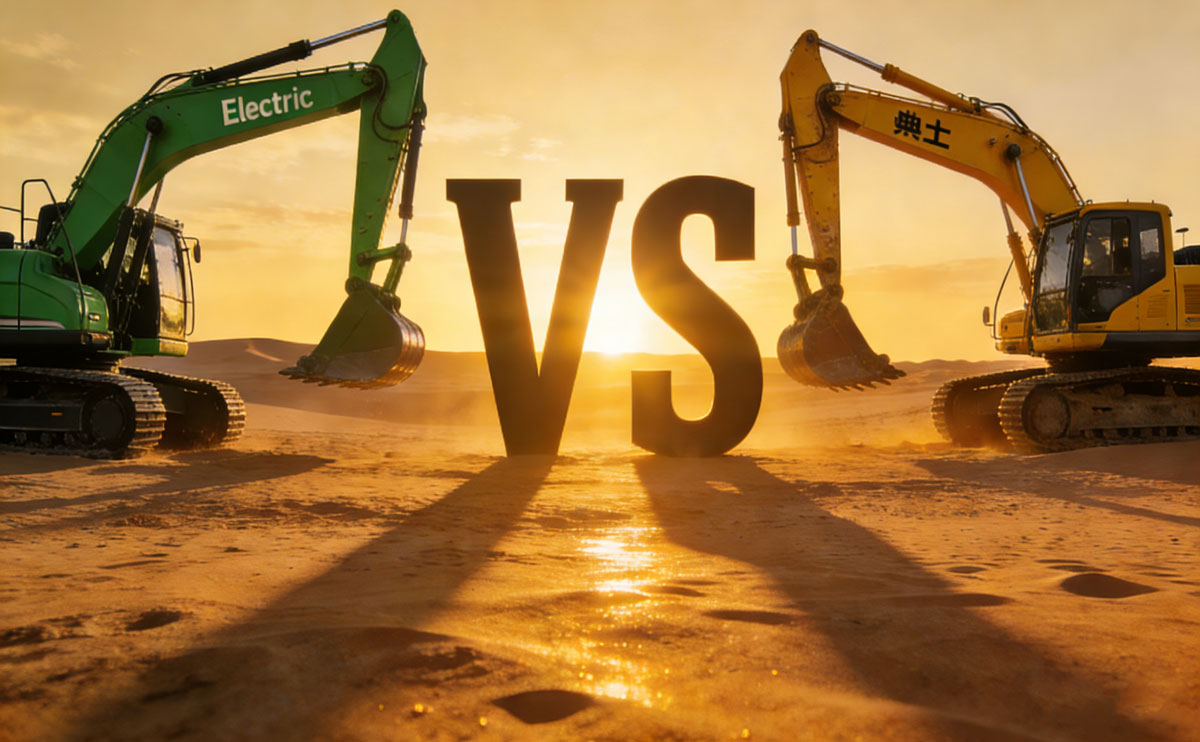
Module 2: Total Cost of Ownership & Technology Comparison
Executive Summary: The Economics of Transition
While market trends show growing interest in electric construction machinery, the real decision for fleet owners hinges on economics and performance. This module provides a detailed head-to-head comparison of diesel and electric equipment across cost dimensions and operational characteristics, with data-driven insights into total cost of ownership (TCO).
The bottom line: Electric equipment offers 48% lower energy costs and 40-50% lower maintenance costs, but requires higher upfront investment. TCO parity is already achieved for compact equipment and is expected for medium machinery by 2028-2030.
Head-to-Head Comparison Table
Source: Compiled from industry reports
| Comparison Dimension | Diesel-Powered Machinery | Electric-Powered Machinery |
|---|---|---|
| Energy Efficiency | 30-40% energy conversion efficiency | 90%+ energy conversion efficiency |
| Emissions (CO₂) | Medium excavator: ~20 tons CO₂/year | Zero direct emissions |
| Noise Pollution | Baseline (85-100 dB typical) | 10-15 dB quieter |
| Fuel/Energy Cost (30-ton excavator) | ~$18,000/year | ~$9,400/year (48% savings) |
| Maintenance Cost Reduction | Baseline | 40-50% lower maintenance costs |
| Lifespan Considerations | Value declines as emissions regulations tighten | Extended life through repowering, higher residual value |
| Cold Weather Performance | Reliable to -30°C | Battery performance degrades below freezing |
| Refueling/Recharge Time | 5-10 minutes refueling | 1-2 hours fast charge (80%), overnight full charge |
Total Cost of Ownership (TCO) Deep Dive
The TCO Equation: Why Purchase Price Isn't Everything
Total Cost of Ownership encompasses all costs over an asset's entire working lifetime: acquisition, energy, maintenance, downtime, regulatory compliance, and residual value.
Current TCO Reality (2026)
According to the Transportation Research Board's 104th Annual Meeting proceedings, projections for 2035 indicate that anticipated reductions in battery prices alone will not make the TCO of electric wheel loaders and excavators competitive with diesel equivalents without government incentives. This finding underscores the critical role of policy support in the transition.
However, the picture varies significantly by equipment size and region:
| Equipment Category | TCO Status (2026) | Breakeven Timeline |
|---|---|---|
| Mini Excavators (≤2 tons) | Already TCO positive in many markets | Immediate |
| Small Wheel Loaders | Positive in China; approaching parity in Western markets | 1-3 years |
| Medium Excavators (20-30 tons) | Still negative without subsidies | 2028-2030 projected |
| Large Mining Equipment | Negative; pilots ongoing | 2029-2032 projected |
The Battery Cost Critical Threshold
IDTechEx research identifies a critical threshold: battery prices must fall below $400/kWh for owners to see ROI before equipment end-of-life. The good news: OEMs scaling to series production can already secure pricing around $300/kWh, dropping potentially to $100/kWh as the industry matures.
Example Calculation: 30-ton Electric Excavator
Battery pack required: 350-450 kWh
At $300/kWh: Battery cost = $90,000-$135,000
Annual fuel savings: ~$8,600 vs. diesel
Annual maintenance savings: ~$3,000-5,000
Simple payback: 8-12 years (depending on utilization)
Technology Comparison Matrix
Performance Characteristics
| Operational Factor | Diesel Advantage | Electric Advantage | Verdict |
|---|---|---|---|
| Peak Power | ✓ High horsepower for heavy loads | Instant torque delivery | Application-dependent |
| Continuous Operation | ✓ 10-16 hours between refuels | 4-8 hours typical | Diesel wins for 24/7 operations |
| Precision Control | Good | ✓ Excellent; smoother, more responsive | Electric superior for precision work |
| Site Versatility | ✓ Works anywhere fuel is available | Requires charging infrastructure | Diesel more flexible in remote areas |
| Indoor/Confined Spaces | Emissions hazardous | ✓ Zero emissions, safer | Electric mandatory for some indoor sites |
Infrastructure Requirements
Diesel Infrastructure:
Existing global fuel supply chain
On-site storage tanks (regulatory compliance required)
Fuel delivery logistics
Electric Infrastructure Requirements:
Depot charging: Centralized overnight charging
Fast charging: 150kW+ chargers for midday top-ups
Mobile charging: Generators or battery containers for remote sites
Grid capacity: May require upgrades for multiple machines
Key Takeaways
Energy and maintenance savings are substantial, but upfront cost remains a barrier.
Payback periods vary widely by equipment size and utilization; compact equipment already pays off.
Battery cost declines are critical to achieving widespread TCO parity.
Infrastructure readiness is a key consideration for electric adoption.
Module 2 of 3 | Report Date: February 14, 2026
Data Sources: IDTechEx, Transportation Research Board, Roland Berger, Urban Mobility Systems
Compliance: E-E-AT Standards (Experience, Expertise, Authoritativeness, Trustworthiness)