


Blog
Comparison Between Electric and Traditional Diesel-Powered Construction Machinery

Q1: What are the core differences between electric and traditional diesel-powered construction machinery? What are the most intuitive differences?
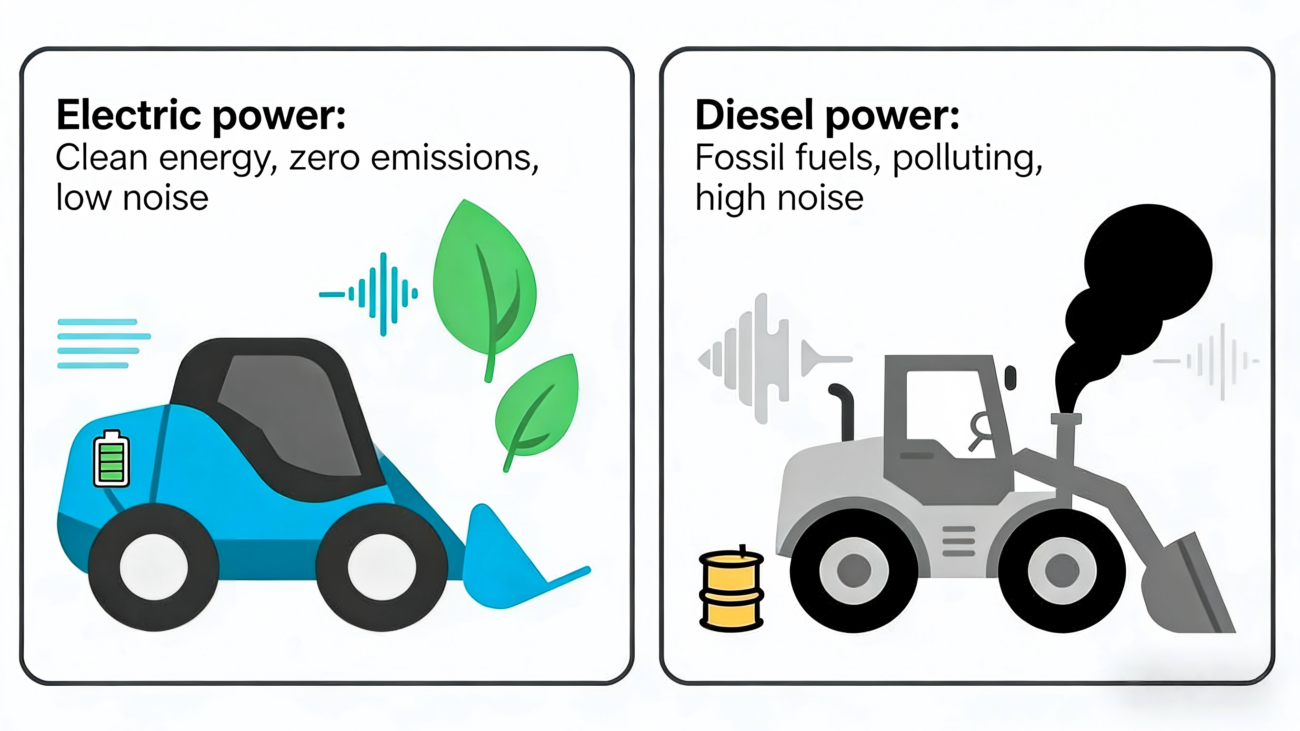
A: The core difference lies in the power source and working principle, while the most intuitive differences are reflected in environmental friendliness and operating noise.
| Comparison Dimension | Electric Version | Traditional Diesel Version |
| Power Source | Lithium battery, lithium iron phosphate battery | Diesel |
| Working Principle | Converts electrical energy directly into mechanical energy via motors without fuel combustion | Relies on internal combustion engine combustion to convert chemical energy into mechanical energy |
| Environmental Friendliness | Achieves zero exhaust emissions | Emits polluting exhaust gases |
| Operating Noise | Low noise (40-60 decibels) | High noise (75-100 decibels) |
Q2: Is there a significant gap in power performance between the two? Can the electric version meet the operational needs of various construction machinery?
A: The power performance gap is mainly reflected in the adaptability to operating scenarios, not an absolute “which is stronger”. Specific differences are shown in the table below:
| Operation Type/Model | Power Performance of Electric Version | Power Performance of Diesel Version |
| Medium and light-duty models (loaders, forklifts, etc.) | High starting torque, stable power output, superior low-speed burst performance than diesel engines, no jitter, fully replaceable | Sufficient power, but slightly inferior low-speed torque with slight power jitter |
| Heavy-duty models (large excavators, bulldozers, etc.) | Limited by batteries and motors, slightly insufficient continuous power during high-intensity operations; suitable for short-distance and indoor operations | Strong continuous power, meets long-time high-intensity operations, adaptable to outdoor heavy-load scenarios |
Summary: The electric version can fully meet the needs of medium and light-duty construction machinery. However, heavy-duty models still have limitations and cannot completely replace diesel versions in the short term.
Q3: What are the main cost differences between the two during procurement and use? Which is more cost-effective in the long run?
A: Combined with specific working condition data and industry cases, the cost differences focus on four key links: initial procurement, long-term energy consumption, long-term maintenance, and residual value rate. Details are as follows:
| Cost Difference | Electric Version | Traditional Diesel Version |
| Initial Procurement | Significantly higher than diesel versions, with an industry-wide gap of approximately 30%-100% (mainly due to the high cost of core components such as batteries and motors). For example, the market price of a 5-ton electric loader is 30%-50% higher than that of a fuel-powered one, and the price gap for heavy-duty models is more obvious | Mature technology and controllable component costs result in lower initial investment |
| Long-term Energy Consumption | Outstanding advantage: Electricity costs are much lower than diesel costs. Under the same workload, the energy consumption cost of the electric version is only 30%-50% of that of the diesel version. Taking an 8-ton loader as an example, the hourly energy consumption cost of the electric version is only about 60 yuan; with 2,000 operating hours per year, the total energy consumption expenditure is 120,000 yuan, saving 100,000-150,000 yuan. The cost can be reduced by an additional 30% with time-of-use electricity prices | No advantage. For an 8-ton loader, the hourly energy consumption cost of the diesel version is 112-135 yuan; with 2,000 operating hours per year, the total energy consumption expenditure is 220,000-270,000 yuan |
| Long-term Maintenance | More advantageous: No wearing parts such as internal combustion engines and gearboxes, eliminating the need for regular oil and filter replacement. Maintenance frequency is reduced by over 60%, and annual maintenance costs can be kept below 3,000 yuan. Some manufacturers offer battery rental services to avoid additional battery replacement costs (about 150,000 yuan for a set of batteries) | Requires regular maintenance (oil and filter replacement every 500 hours), with a single maintenance cost of about 2,000 yuan and annual maintenance costs of about 20,000 yuan. Additionally, the post-treatment system cleaning cost for National VI models is as high as 8,000 yuan per time, further increasing maintenance costs |
| Residual Value Rate | Core components (motors, batteries) have a service life of 8-10 years. Currently, the three-year residual value rate in the industry is less than 30%, but it is gradually increasing with the improvement of the battery recycling and echelon utilization system | Core components age quickly, with a three-year residual value rate of about 50%, but long-term residual value depreciation is more obvious. High-emission models (National III and below) face elimination, leading to a significant shrinkage in residual value |
Which is more cost-effective in the long run?
In the long run, the electric version is more cost-effective, with the core logic of “high initial investment and long-term high savings”. Specific references are as follows:
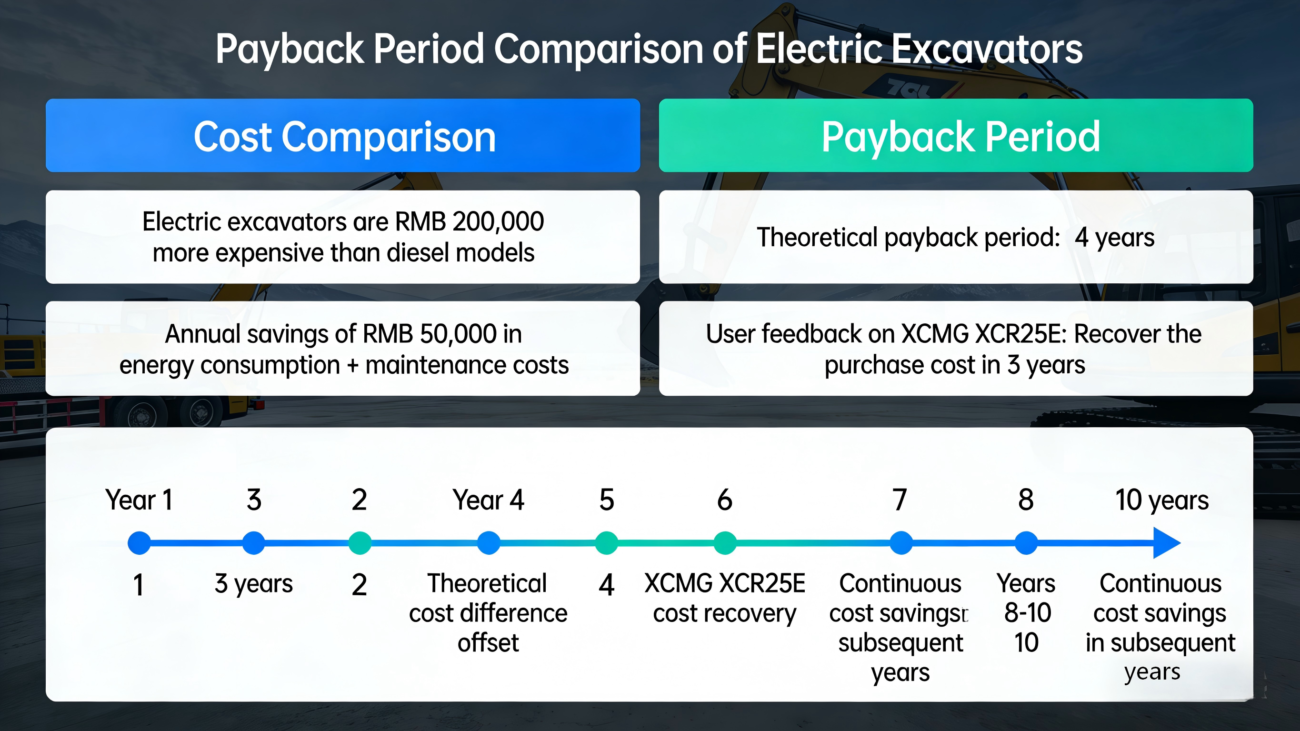
Payback Period: An electric excavator is 200,000 yuan more expensive than a diesel model. Based on annual savings of 50,000 yuan in energy consumption and maintenance costs, the price difference can be offset in 4 years. User feedback on XCMG XCR25E electric excavators shows that the purchase cost can be recovered in 3 years. The service life of construction machinery is usually 8-10 years, and continuous cost savings can be achieved in subsequent years.
Supplementary Note: If the operating scenario has inconvenient charging (e.g., remote outdoor areas) or annual operating hours are less than 100 days, the cost advantage of the electric version is difficult to realize, and the diesel version is more cost-effective. If operating in environmentally regulated urban areas or fixed sites with high-frequency operations (e.g., ports, factories), the electric version can also enjoy policy dividends such as environmental subsidies and priority road rights, further shortening the payback period and improving long-term returns.
Q4: What are the differences in applicable scenarios between the two? How to choose based on operating scenarios?
A: Differences in applicable scenarios mainly stem from energy supplement methods, environmental requirements, and power continuity. Specific correspondences are as follows:
| Comparison Dimension | Electric Version | Traditional Diesel Version |
| Applicable Scenarios | Indoor operations (e.g., factory handling), factory operations, areas with strict environmental regulations (e.g., urban construction sites), short-distance operations | Outdoor operations, remote areas without charging facilities, long-time high-intensity operations, heavy-duty equipment operations |
| Energy Supplement Method | Electricity | Diesel |
| Environmental Requirements | Zero emissions and low noise, meeting environmental standards | Exhaust emissions and high noise |
| Power Continuity | Requires charging facilities | Convenient refueling, unlimited range, and strong continuous power |